


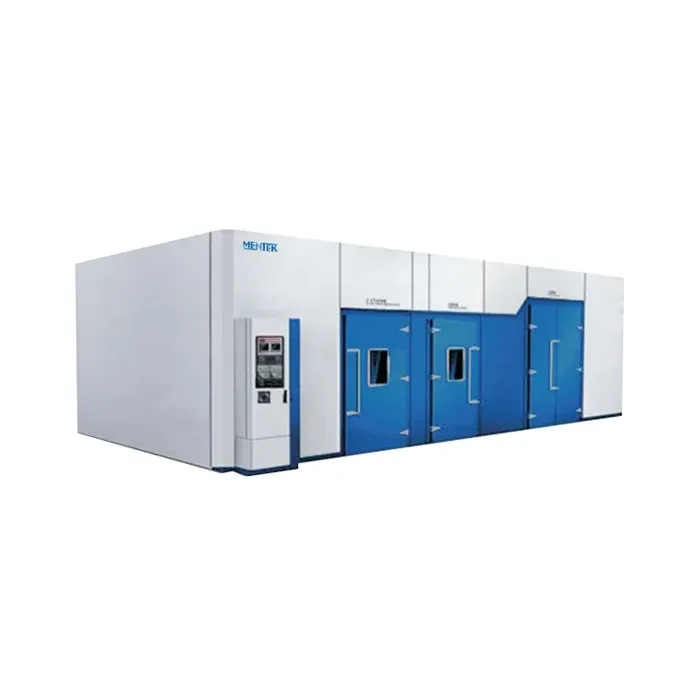
Environmental Testing for Modern Vehicles: How Integrated Climatic Chambers Address Multi-Physics Validation Challenges
1. The Multi-Physics Coupling Challenge in Modern Vehicle Development
The conventional approach to vehicle environmental testing was built around a simpler vehicle architecture: an internal combustion engine, a basic electrical system, and a handful of sensors. Each subsystem could be validated in isolation. That world no longer exists.
Today's electrified vehicles introduce three interlocking validation problems that cannot be solved with isolated test equipment:
EV Thermal Management Complexity
The traction motor, power electronics (inverter, OBC, DC-DC converter), and high-voltage battery pack form a thermally interdependent system. At -40°C, the battery requires active heating to maintain minimum cell temperature for safe charging; simultaneously, the motor and inverter may overheat under hard acceleration because the cabin air is too cold to provide effective convective cooling. At +50°C desert ambient, the battery requires aggressive liquid cooling while the climate control system competes with the traction inverter for available cooling capacity. Validating this thermal balance requires the chamber to impose precise, sustained temperature conditions while the vehicle operates under real powertrain loads — not just static soak.
Automotive EE System Fragility Under Climatic Stress
Modern vehicles carry 150 or more ECUs and thousands of sensors. ISO 16750 — the governing standard for environmental conditions of road vehicle electrical and electronic equipment — defines demanding humidity, temperature cycling, and condensation requirements for each. A single ADAS radar module or LIDAR window heater that fails under rapid humidity cycling can compromise the entire ADAS stack. Testing these components in situ, within a full-vehicle chamber under dynamic thermal and humidity profiles, reveals failure modes that component-level bench tests consistently miss — because they miss the thermal gradients, mechanical vibration, and actual power-on load that exist when the system operates in a complete vehicle.
Multi-Standard Global Regulatory Convergence
A globally sold vehicle platform must simultaneously satisfy Euro 6d/Euro 7 (WLTP test cycle, -7°C cold start requirement), EPA FTP-75 and US06 (cold temperature CO emissions testing at -7°C and -20°C), and GB 18352.6 (China 6b, incorporating WLTC). Each standard specifies different ambient temperature conditions, soak periods, and drive cycles. A chamber that cannot replicate each of these boundary conditions — with certified accuracy — forces automotive OEMs to conduct separate certification campaigns in different geographic test facilities, multiplying cost and program risk.
2. Core Technical Specifications: Translating Parameters Into Engineering Capability
Raw specification numbers on a datasheet tell only part of the story. What matters is the engineering capability those numbers represent under real vehicle operating conditions.
Extreme Thermal Ramp Rates and Their Impact on Time-to-Market
The ability to transition from +25°C ambient to -40°C in under three hours is not merely a performance specification — it is a development cycle multiplier. A chamber that requires eight hours to reach -40°C limits a test team to one cold-soak cycle per shift. A chamber that achieves it in three hours enables two full cycles per shift, cutting cold-climate validation calendar time by nearly 40%. For automotive programs under intense time-to-market pressure, this compression can mean the difference between hitting a design freeze date and missing a product launch.
Equally important is the rate of temperature rise under solar simulation. Replicating a parked-car interior reaching +80°C cabin temperature within a controlled timeline — rather than waiting for ambient stabilisation — enables repeatable thermal stress tests for interior trim, HVAC systems, and in-cabin electronics.
Thermal Load Rejection Under Full-Vehicle Power Dissipation
This is the single most important specification that separates an industrial-grade automotive environmental chamber from a scaled-up laboratory unit: the ability to maintain temperature setpoint stability when the test vehicle is generating maximum heat dissipation.
A full-size electric SUV under wide-open-throttle conditions on a chassis dynamometer can dissipate 3,000 W or more of waste heat into the chamber interior through exhaust, motor cooling, and radiated heat from the powertrain. A chamber that maintains ±1°C to ±2°C temperature uniformity under this thermal load — rather than drifting by ±5°C or more — is engineering the test condition, not merely approximating it. The refrigeration capacity, airflow management, and control algorithm must be sized and tuned specifically for vehicle heat loads, not interpolated from smaller chamber designs.
Compound Environmental Control: Temperature, Humidity, and Solar Radiation
Real-world environments do not present single-variable conditions. A vehicle parked in the Rub' al Khali desert at solar noon experiences simultaneous ambient temperature of +48°C, relative humidity below 10%, and solar irradiance exceeding 1,000 W/m². A vehicle in a Nordic winter experiences -35°C, 90% relative humidity, and near-zero solar input. Validating climate control, defrost systems, and battery thermal management under these compound conditions requires a chamber capable of simultaneously controlling:
- Temperature across the full operating range (typically -40°C to +60°C or higher)
- Relative humidity from 10% to 98% RH with precision control
- Solar simulation at up to 1,200 W/m² using multi-spectrum lamp arrays that replicate the spectral content of natural sunlight
- Fresh air exchange rate to simulate altitude-related oxygen partial pressure changes
The interaction between these variables — particularly the latent heat load introduced by humidity control at extreme temperatures — demands a refrigeration and dehumidification system engineered as an integrated unit, not assembled from independent subsystems.
3. System Integration: Environmental Chamber and Chassis Dynamometer in Sync
The true differentiator of an automotive integrated environmental test chamber is not the chamber itself — it is the seamless interface with the chassis dynamometer (dyno) and the vehicle's on-board systems. Without this integration, the chamber is simply a large temperature-controlled room.
Dynamometer Interface and Road Load Simulation
The chamber floor accommodates roller sets matched to the vehicle's axle configuration — single axle for FWD/RWD testing, dual axle for AWD — with structural load ratings appropriate for commercial vehicles and SUVs. The dyno interface manages road load simulation (coastdown-derived drag and rolling resistance curves), gradient simulation, and inertia simulation for accurate WLTP and FTP-75 cycle execution. The chamber structure is designed to transmit zero vibration into the dynamometer measurement system, preserving force measurement accuracy at the wheel contact point.
Exhaust Extraction System: Cold-Weather Engineering
Exhaust gas management is one of the most technically demanding subsystems in a low-temperature automotive test chamber. At -20°C and below, raw exhaust gases exiting the tailpipe contain sufficient water vapour to immediately form ice in any unheated extraction ductwork — blocking flow, generating dangerous CO/NOx backpressure, and potentially allowing combustion gases to escape into the occupied test area.
A properly engineered exhaust extraction system addresses this through:
- Heated flexible couplings at the tailpipe connection point, maintaining gas temperature above condensation threshold throughout the extraction path
- Insulated, trace-heated ducting from the vehicle exit point to the chamber wall penetration, preventing condensation and ice blockage even at -40°C ambient
- Continuous CO and NOx monitoring at the chamber air return plenum, with automatic alarm and forced-ventilation interlock to protect personnel
- Variable-speed extraction fan matched to engine displacement and test cycle load profile, maintaining consistent backpressure at the tailpipe across idle to full-load conditions
Coolant Conditioning and High-Voltage Power Supply Management
For battery electric vehicle testing, the chamber provides a dedicated coolant conditioning circuit — a tempered glycol loop that connects to the vehicle's external cooling interface, allowing independent control of battery thermal management fluid temperature independent of the chamber ambient. This enables targeted battery temperature control (for example, holding the battery at +25°C while soaking the vehicle cabin at -40°C) — a test condition critical for understanding cold-weather range degradation mechanisms without conflating battery chemistry effects with vehicle thermal effects.
High-voltage charging and discharge connections are routed through chamber wall penetrations rated for the appropriate voltage and current class, with EMC shielding to prevent interference with the vehicle CAN bus and measurement systems.
4. Regulatory Compliance: Your Test System as a Certification Gateway
A chamber that meets its own internal calibration specification but cannot be correlated to a recognised standard is not a compliance tool — it is a development aid. For automotive OEMs and Tier 1 suppliers seeking type approval, the chamber must be demonstrably aligned with the test conditions specified by each regulatory body.
| Standard / Protocol | Scope | Chamber Requirement |
|---|---|---|
| WLTP (UN GTR No. 15) | Worldwide harmonised light-duty vehicle test procedure | 23°C ± 2°C soak; -7°C cold-start option; humidity control during cycle |
| EPA FTP-75 / US06 | US federal emissions and cold-temperature CO | -7°C and -20°C cold soak; ±0.5°C soak uniformity |
| GB 18352.6 (China 6b) | Chinese light-duty vehicle emission standard | WLTC cycle; -7°C cold start; equivalent thermal soak conditions |
| ISO 16750 | Electrical/electronic equipment environmental conditions | Temperature cycling, humidity, condensation, solar radiation profiles |
| QC/T 658 | Automotive air conditioning system performance | Solar load simulation, high-temperature cabin soak, humidity control |
| IEC 60068-2 series | Environmental testing for electronic equipment | Temperature/humidity cycling, thermal shock, condensation resistance |
For high-altitude market validation (China's Tibetan Plateau, Andean markets, Rocky Mountain states), chambers equipped with low-pressure simulation capability can replicate altitudes from sea level to 5,000 m, enabling HVAC performance, engine management, and battery range testing under reduced atmospheric pressure without geographic relocation of the test programme.
5. Safety and Explosion Protection: Engineered for High-Voltage and Combustion Coexistence
An automotive environmental test chamber operates simultaneously with high-voltage lithium battery packs (up to 800V DC in current-generation EVs), hydrocarbon fuel systems, and exhaust gases. The safety architecture must address all three hazard classes without compromising test fidelity.
Thermal Runaway Containment
For EV battery abuse testing or accelerated aging studies where thermal runaway is a credible risk, the chamber incorporates:
- Explosion-resistant observation windows with multi-layer laminated glass rated for internal overpressure events
- Dedicated pressure relief ports sized for the maximum credible gas generation rate of the battery pack under test, venting to a safe external discharge point
- Explosion-proof door retention chains preventing door ejection during a rapid internal pressure event
- Interior Teflon coating on metal surfaces, providing electrical insulation between battery terminals and chamber walls and eliminating accidental short-circuit paths
Multi-Layer Redundant Protection for 24/7 Unmanned Operation
Automotive development programmes increasingly rely on overnight and weekend test runs to maximise chamber utilisation. The safety interlock architecture must be designed for unattended operation without compromise:
- Independent mechanical over-temperature protection: a dedicated electromechanical thermostat, physically separate from the primary PID control loop, that cuts power to heaters at a fixed threshold regardless of controller state
- Electronic over-temperature protection: a secondary software watchdog monitoring all temperature sensors at 1-second intervals, triggering controlled shutdown on sensor deviation exceeding defined limits
- Refrigeration system pressure protection: high and low-pressure cutouts on both compressor stages, with automatic lockout preventing restart after a fault condition
- CO and combustion gas monitoring: continuous electrochemical detection with automatic forced exhaust ventilation and test program pause on alarm
- Remote monitoring interface: real-time chamber status, active alarms, and test program status accessible via network connection to the facility safety monitoring system
6. Customisation and Turnkey Delivery: From Ground Preparation to Final Acceptance
An automotive walk-in environmental chamber of this scale is not purchased off a shelf. It is an engineered asset, specified and delivered as a turnkey project. Understanding the full delivery scope is essential for accurate budget planning and programme scheduling.
Vehicle-Specific Interior Dimensioning
Internal dimensions are specified around the vehicle envelope plus required clearances for personnel access, instrumentation wiring, exhaust coupling, and cooling circuit connections. A compact EV hatchback programme has fundamentally different chamber requirements from a full-size commercial van or a heavy-duty truck cab validation project. Standard offerings cover passenger cars and light commercial vehicles; oversized configurations for buses, trucks, and specialty vehicles are engineered on a project basis.
Data Acquisition and LIMS Integration
The chamber control system exposes an open data interface — typically Modbus TCP, OPC-UA, or a direct API — that allows the chamber's temperature, humidity, solar load, and safety status data to be ingested directly into the customer's Laboratory Information Management System (LIMS) or vehicle data acquisition (DAQ) platform. This eliminates manual data transcription, enables real-time test condition verification against regulatory specifications, and provides a complete, auditable environmental record for each test run — a requirement for regulatory submission packages.
Where customers operate existing data acquisition infrastructure (e.g., National Instruments, HBK, or ETAS platforms), the chamber control architecture can be configured to operate as a controlled peripheral within those ecosystems, receiving setpoint commands and transmitting process values over standard industrial protocols.
Full-Cycle Project Delivery
The delivery scope for a purpose-built automotive environmental chamber extends well beyond equipment manufacture:
- Site preparation consultancy: foundation load calculations, utility supply specifications (power, cooling water, compressed air, exhaust duct routing), and crane access planning for equipment installation
- Factory Acceptance Test (FAT): full performance verification at Mentek's facility before shipment, including temperature uniformity mapping under representative thermal load, safety interlock functional testing, and regulatory cycle simulation
- Logistics and installation: oversized transport management, on-site assembly, mechanical and electrical commissioning, and integration with the customer's dynamometer and DAQ systems
- Site Acceptance Test (SAT): final performance verification and customer sign-off at the installed location, with calibration certificates traceable to national measurement standards
- Operator training and ongoing support: structured training programme for chamber operators and maintenance personnel, supported by remote diagnostic capability and a documented spare parts programme
Conclusion: One Chamber, Every Climate, Every Standard
The complexity of modern vehicle development — driven by electrification, advanced driver assistance, and diverging global regulatory requirements — has outpaced the capability of conventional, single-variable environmental testing approaches. The automotive integrated environmental chamber represents the convergence of climatic control engineering, safety system design, and vehicle interface expertise into a single, validated test asset.
At Mentek, our Automotive Comprehensive Environment Simulation Testing Cabin is engineered to meet the full scope of these demands — from compound climatic control and chassis dynamometer integration to explosion-proof safety architecture and turnkey project delivery. If your programme requires a vehicle-level environmental test capability, our applications team is ready to review your specific vehicle class, test standards, and facility constraints.
|
Discuss Your Automotive Environmental Test Requirements With Our Engineering Team Request a Free Technical Consultation View Automotive Test Chamber |